

Written by Anuja, Anushree & Krishnan on 06 January 2026
Ten years ago, the Shankar Mahadevan Academy - a not-for-profit charitable Trust - began an initiative in Bengaluru: Can we teach music to children with autism? We named that initiative the Joyful Choir.
Here is a story from the very first class, as told by Sridhar Ranganathan, who founded the Academy with his dear friend Padma Shri Dr Shankar Mahadevan.
Sridhar said, “In that first class, the children were restless - some were in their own world, some ran around the room. There was chaos. Our teacher did not know how to begin. From sudden inspiration, I told her, ‘Play the National Anthem’. And suddenly, chaos turned to calm. The children, the parents, and all of us stood together in attention and sang. Tears started rolling down many an eye in that room. I could see the power of the Joy of Music - right before my eyes.”
Years passed; the program grew. At SANGAM, our global concert series, the legendary musician John McLaughlin was the guest of honour. Watching the Joyful Choir children perform, he was so deeply moved that he said - For music, what can be a more beautiful purpose?
Then, the pandemic forced us to pause.
Two years ago, in April of 2023, Believe reached out to support one of our social initiatives. When I shared our work, they chose Joyful Choir - because it stood for inclusion. (Believe is a digital platform that supports young artists to share their music with the world.)
With support from Believe, we started Joyful Choir in Mumbai, at Jai Vakeel Foundation, Academy of Learning and Development, Cotton Green; the Academy of Learning and Development, Andheri; and Kshitij School for Special Children, Dombivli. Close to 50 children enrolled (all of them with mild to moderate autism) - to be guided by two compassionate music educators, Anuja Mhatre and Anushree Datar.
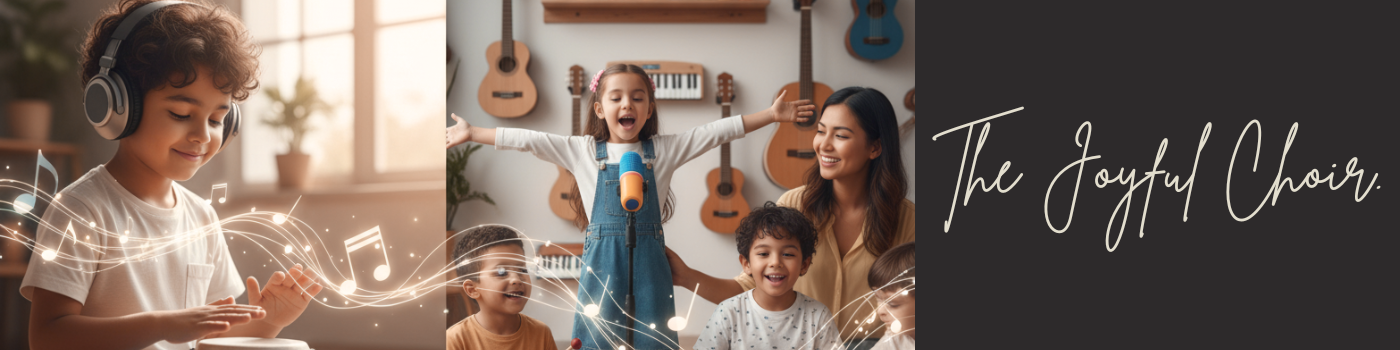
And the journey began - teachers and children sitting in a circle and singing as one. In that circle, there were no teachers, no students - just people basking in the Joy of Music.
Let us take you into that circle through the voices of teachers, Anuja Mhatre and Anushree Datar..
When I began, I knew I had to change the way I teach. Children living with autism cannot be taught like other students. I had to slow down, improvise, and above all, be patient.
I stopped chasing perfection. What mattered was not whether they hit the exact note. What mattered was that they were expressing themselves. Were they enjoying the music and staying engaged? That shift changed everything for me.
I began with Swaras and rhythm. Rhythm gave them structure, and suddenly they could stay with the music longer. Songs were harder to learn, so I turned the songs into elements of play: small groups of children, tiny challenges, fun competitions. Suddenly, the joy in the children came alive.
I remember Aditya Menon. In the beginning, he would not even speak. Then one day, after months of silence, Aditya sang out loud with confidence. It felt like a door had opened.
Krish Ambekar came to class with the Joyful Choir, already knowing something about how to play the keyboard. Now he plays with both hands - chords and melody, at the same time. Krish has become the backbone of the group, a natural, upright leader the others lean on.
Then there is Chaitanya Devkar. At first, he only sang devotional songs. He even took a long break. When he came back, he used to hum quietly, his head down. But now, he sings every song - and sometimes asks to sing solo. To see him come forward like that has been pure joy.
There were surprises, too. Like the day all the children sang the song Heal the World together. Or when they learned a song named One World in just four classes - breaking their own record. Previously, they would take at least three times the number of classes to learn a song.
Parents tell me the music has followed them home - the children now video call each other to jam together. Children also seize any opportunity to perform outside the Joyful Choir, on their own initiative. Clearly, their confidence has grown.
And the most touching change? How they care for each other. At performances, they hold hands and make sure no one is left behind. That, too, is all because of music - it is music teaching them to connect.
Every step of progress is bliss for me. Every performance is emotional - the smiles, the relief, the joy in the end. In this journey, I have learned that music is not about perfection. It is about expression. And the more you express, the more you connect with others.
When I first heard that I would be teaching music to these children, I was nervous. But they welcomed me so warmly that my nervousness evaporated. Our very first trial session was full of fun. I even made a few little songs just for them, and that showed me how much they could learn.
The children learn in a different way than most of us do. For example, they prefer not to read from books or blackboards nor use a pen or chalk. Therefore, I had to find another way.
I used stories and acting. For example: “Imagine a building. On the first floor is Sa, the second is Re… Now, which is the sixth floor?” And they would laugh and shout, “That is Dha!” Then I would tell them, “The terrace is the upper Sa.”
Slowly, the children could sing two or three songs with tracks. That gave me so much happiness.
Some songs, I guided the children to enact a song. The children joined me in acting and loved it - that is the way I had them learn the song Dil Hai Chhota Sa, or the Marathi folk song Chik Motiya Chimmar, which they sang beautifully. That was how we began - singing alankars (forming phrases of two or three musical notes, simple patterns of musical notes, and lots of play.
We also practised rhythm by tapping on benches: one-two-three, or one-two-three-four. This made them familiar with rhythm and gave them confidence.
Some children even began to prepare songs in their own way. Swaraj Mane, a child with a serious look, who had difficulty speaking, made the effort to sing with a partner. That moment touched me deeply.
A few of the children, like Neha Shah, could not say words clearly for others to hear. They formed words with their mouths, but the sounds of the words would stay inside - we could hear it as a mumble. I found that as they began singing, over time, they gradually made the words of the song heard by us. They could articulate the words of a song while singing. It makes me wonder - can their singing help them do the same thing with their speech?
These sessions taught me that with stories, with acting, with rhythm and play, music can find its way to every child. And when I saw them sing with joy, I felt the biggest reward.
The children find their voices
What change have we seen over the past 18 months? The children can now express themselves musically. They can feel music inside them, and they can show it outside - by singing, moving, and playing. It is only the start of their journey, but we are quietly excited about where it may lead.
And sometimes, that expression leads to something bigger. One month ago, at the Cube in the Nita Mukesh Ambani Cultural Centre, 10 children stood together as the Joyful Choir and sang an original song they helped create: One World - a song about inclusion, created through inclusion.
One World was born from conversations with the children. When I asked, “What does the word inclusion mean to you? - Their answers were simple: “Give everyone a chance to sing.” “Anyone with talent should get a chance.” I shaped these thoughts into lyrics.
I gave the song a simple melody, and then let the children build it. Dyaneshwar, who usually stayed with the bongos, with a gentle nudge, sat on the cajon and found his own beat. Tanish picked up the rhythm with the shakers without being told. Rishikesh tried the higher pitch in the chorus “One World Together” - and his voice lifted the whole song.
Piece by piece, the song came alive like a jam session. Every child added an element of beauty and joy to the song.
Transformation is gradual but clear.
For these children, music now is Expression. It is as though they say: I am here. This is my voice. And I can share it with you.
