Written by Chaitra Sontakke on 07 September 2026
Journey of the Tanpura
For a student, it takes time to procure a good Tanpura and, more importantly, tune the instrument perfectly in order to practice. For children, this may be a difficult task to perform. Hence, the electronic Tanpura was innovated by Radel Electronics. Though the reception to this instrument was slow initially, the idea picked up among the students who travelled for work or studies. They found it an easy replacement to carry around. Practice could be done anywhere, anytime!
In this era of Smartphones and apps, the idea of an electronic Tanpura took no time to upgrade into an app. These apps are auto-tuned, hence demand no skill from the student. Students only need to choose the right key, and they can find a perfectly tuned Tanpura playing for their practice. The Tanpura is in one’s pocket, and using earphones and playing it to oneself could be a good option to practice sometimes. Though apps cannot replace the feel of the original Tanpura, the apps are used at concerts and sometimes in order to maintain an accurate reference even to the real Tanpura. Real instruments are often affected by weather and strong lights, but the apps perform accurately.
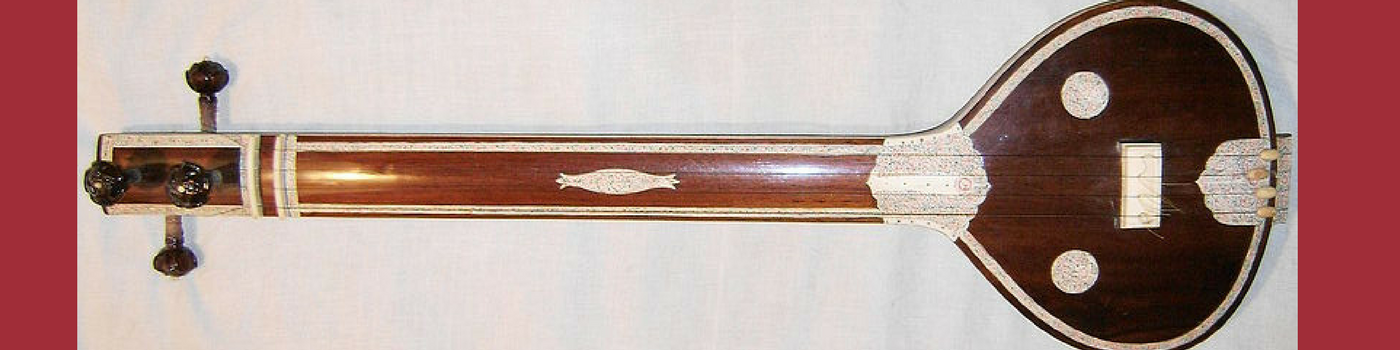
There are different Tanpuras available to suit a male voice and a female voice. The male voices are generally in the Shrutis between C, C#, D. The female voices are in the range of G#, A, A#. Children’s voices are in the same range as female voices. The male Tanpuras are larger in size, and the gauge of the strings used is suitable for the male Shrutis. The female Tanpuras are constructed with strings suitable for specific Shrutis ranging from G# to A#. Tanpura strings can be customised to one’s Shruti. Using different gauge strings.
The electronic Tanpuras by Radel or any other company are auto-tuned. To use the device, follow the steps given below after switching on the device:
Select from G, G#, A, A# for a female voice and C, C#, D for a male voice. A child’s voice could range from G# to B. Use the increase and decrease arrows to choose your pitch.
Make sure that your Tanpura is in Octave 3, this is presented by the suffix - A3. In a real Tanpura, strings of different gauge are used for a female voice Tanpura and a male voice Tanpura.
For the first string of your Tanpura – 3 options are given - Pa , Ma , Ni. By default the Tanpura is in Pa. You may change it to Ma or Ni when you are required to sing Ragas which do not include Pa in the Aaroh Avaroh. For general purpose, make sure that your first string option selected is Pa.
In the Hindustani pluck style, the Pancham is played for a shorter duration of one count sustain. The four strings are played at uniform intervals. In the Carnatic pluck, the first string Pa is played for a longer duration of 2 counts sustain. The Sa strings are played for one count. Choose your pluck style by pressing and holding 2 arrow switches as indicated on the device.
The OM Book (Online Music Book - learning material for Shankar Mahadevan Academy students) has an inbuilt electronic Tanpura for practising; it helps in acquiring clarity of voice, focusing on the stability of the note and matching the student’s pitch perfectly with the Tanpura.
The e-Tanpura allows you to select the scale you’d like to practice in.
OM Riyaaz Recorder in the OM Book is an integrated practice tool which allows students to:
Want to sing in perfect pitch? Find out about it in our next post. Stay tuned!